Pick up a silver bangle in a Dubai souk and flip it over — you'll probably see "925" stamped into the metal. That tiny number is the difference between paying AED 7.28 per gram and paying AED 7.87 per gram for what looks like identical silver. As an illustrative example, silver spot is around $66.62 per troy ounce (see the live table above for the current figure), but which grade of silver you're buying changes both what you own and what you pay.
The Three Silver Purity Grades You'll Actually Encounter
Silver isn't sold as a single product. Like gold karats, silver comes in purity grades — and confusing them costs you money either way: overpaying for low-purity pieces, or undervaluing what you already own.
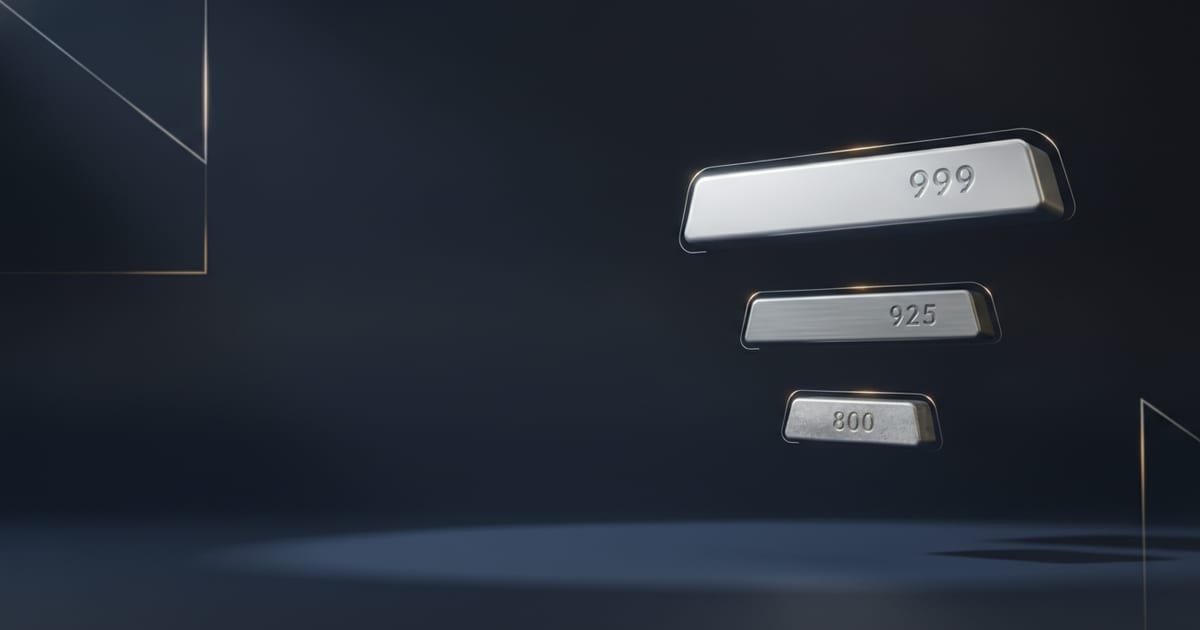
Here's how the three main grades break down:
| Grade | Purity | Common Name | Typical Use | Price per gram (at time of writing) |
|---|
| 999 | 99.9% pure | Fine silver / Bullion silver | Bars, bullion coins, investment-grade rounds | USD $2.14 / AED 7.87 / SAR 8.03 / EGP 106.74 / QAR 7.80 / KWD 0.66 |
| 925 | 92.5% pure | Sterling silver | Jewelry, cutlery, decorative items | USD $1.98 / AED 7.28 / SAR 7.43 / EGP 98.74 / QAR 7.21 / KWD 0.61 |
| 800 | 80% pure | Continental silver | Older European silverware, some antiques | USD $1.71 / AED 6.29 / SAR 6.43 / EGP 85.39 / QAR 6.24 / KWD 0.53 |
Those prices are live at the time of writing — silver moves daily, so check the live silver price for your country on DahabPulse before any transaction.
The spread between 999 and 800 is about 25% per gram. On a 100-gram piece, that's the difference between paying roughly AED 787 and AED 629 in pure silver value — before any markup.
What Each Grade Is Actually For
999 Fine Silver — the investor's metal
999 silver is as pure as silver gets in practice. You'll find it in investment bars (from refiners like PAMP and Valcambi), and in bullion coins like the Canadian Silver Maple Leaf and the British Silver Britannia. Because it's nearly pure, it's softer than alloys — too soft for most wearable jewelry. A 999 silver ring would bend, scratch, and lose shape quickly. That's fine if you're stacking bars in a safe, but not if you're wearing something daily.
For GCC investors buying silver as a store of value — particularly in Saudi Arabia, the UAE, and Kuwait — 999 bars and recognized bullion coins are the standard. The metal content is exactly what it says, making valuation simple.
925 Sterling Silver — the jewelry standard
925 sterling is what almost all silver jewelry is made from. The 7.5% added metal — usually copper — gives it the hardness needed to survive daily wear. The British standard for sterling has existed for centuries, which is why the term "sterling" carries weight as a quality indicator even in markets that never had British coinage.
If you're buying silver jewelry in Dubai, Riyadh, Cairo, or Doha, 925 is the grade you'll see in reputable shops. A bracelet stamped 925 means 92.5 grams of pure silver per 100 grams of total weight. As an illustrative example, that pure silver content is worth around AED 7.28 per gram (see the live table above for the current figure) — but you'll pay a craftsmanship premium above that in any retail store.
800 Silver — the antique dealer's grade
800 silver is uncommon in new jewelry today, but you'll encounter it in antique markets — particularly in older European silverware, vintage Arabic coffee sets, and some inherited pieces from the mid-20th century. It's 80% pure silver with 20% base metals. Some older Gulf and Levantine silverwork was made to this standard.
If you're buying a vintage piece and the seller quotes a price based on "silver content," be precise about the grade. As an illustrative example, 800 silver is worth around AED 6.29 per gram in pure metal (see the live table above for the current figure) — that's about 20% less per gram than 999. On a 200-gram antique piece, the difference in metal value alone is around AED 316.
How to Read Silver Hallmarks
Hallmarks are your proof. Without them, you're taking someone's word for the grade.
Common stamps to look for:
- "999" or "999.0" — fine silver. Sometimes written as "Fine Silver" on bars.
- "925" — sterling silver. May also appear as "S925", "STER", or "Sterling".
- "800" — continental silver. Common on older European and some regional antique pieces.
- "835" — another continental standard you'll see on antiques, slightly purer than 800 but less common than 925.
- A maker's mark — a symbol or initials from the manufacturer or assay office, required in many jurisdictions alongside the purity stamp.
In the UAE, the Emirates Authority for Standardization and Metrology (ESMA) oversees hallmarking requirements for precious metals sold locally. In Egypt, the Precious Metals Control Administration manages assay offices. Always buy from registered retailers in your country if hallmark authenticity matters to you — and for investment-grade silver, it always should.
One practical check: if a piece is labeled 925 but has no visible stamp, or the stamp looks etched rather than struck, treat that as a red flag. Legitimate manufacturers strike hallmarks cleanly into the metal.
What the Silver Market Has Done — Our Recorded Data
Here's where context matters. Since DahabPulse began recording daily silver prices (approximately 7 weeks ago), we've watched silver move dramatically. Our recorded high was $87.50 per troy ounce on May 13, 2026. By June 10, 2026, silver had dropped to our recorded low of $63.42 — a fall of roughly 27.5% from peak to trough in under a month.
As of our latest recorded close on June 21, 2026, silver sat at $64.79 per troy ounce — still near that recent low. The last 7 days have seen a decline of 4.8%, and the last 30 days are down 14.2% from our recorded window.
Why does this matter for a purity explainer? Because the grade you hold affects how you weather volatility. 999 fine silver trades closest to spot — its value is almost entirely tied to the silver price itself. A 925 piece carries both the metal value and a craft premium; when silver drops 14% in 30 days as our data shows it has, the metal portion of your 925 jewelry falls accordingly, but a well-made piece retains some residual value from craftsmanship. 800-grade antiques are harder to liquidate quickly at a fair price precisely because buyers need to verify the grade and the metal value is lower to begin with.
For live, up-to-date silver prices across all GCC currencies, see the DahabPulse silver price tracker for Saudi Arabia or use the gold and silver calculator to work out the exact metal value of any piece by weight.
Frequently Asked Questions
Q: What is the best silver purity grade for investment?
999 fine silver is the best grade for investment purposes because it contains 99.9% pure silver and trades closest to the spot price. Investment bars and bullion coins from recognized refiners and mints use this grade, making valuation and resale straightforward.
Q: Is 925 silver real silver?
Yes, 925 sterling silver is genuine silver — it's 92.5% pure silver, with the remaining 7.5% typically being copper to add hardness. It's the international standard for silver jewelry and is considered high-quality silver in every major market including the UAE, Saudi Arabia, and Egypt.
Q: Why is 800 silver cheaper than 925?
800 silver contains only 80% pure silver compared to 92.5% in 925 sterling, so there's simply less silver per gram. As an illustrative example, 800 silver is worth approximately AED 6.29 per gram in metal content, versus AED 7.28 per gram for 925 (see the live table above for current figures) — about an 8% discount purely from lower purity. The remaining 20% is base metal with minimal intrinsic value.
Q: How do I check if my silver jewelry is genuine?
Look for a stamped hallmark — "925", "999", or "800" — struck into an inconspicuous part of the piece such as the clasp, inner band, or back of a pendant. A legitimate hallmark is pressed into the metal, not painted or engraved loosely. For high-value pieces, request an assay certificate or take the item to an accredited assay office in your country.
Q: What does the "S925" stamp mean on silver jewelry?
S925 means the piece is sterling silver at 92.5% purity — the "S" simply stands for silver, and the 925 is the purity grade. It carries exactly the same meaning as a plain "925" stamp and is commonly used by Asian and European manufacturers on jewelry exported to the Gulf and wider Middle East markets.
For the most accurate gram prices in your local currency — whether you're pricing a 925 bracelet in Egyptian pounds or valuing 999 bars in Kuwaiti dinars — visit DahabPulse.com and use the precious metals calculator to run the numbers yourself. Prices shown in this article were accurate at the time of writing; silver spot moves every trading session, so always check the live rate before buying or selling.