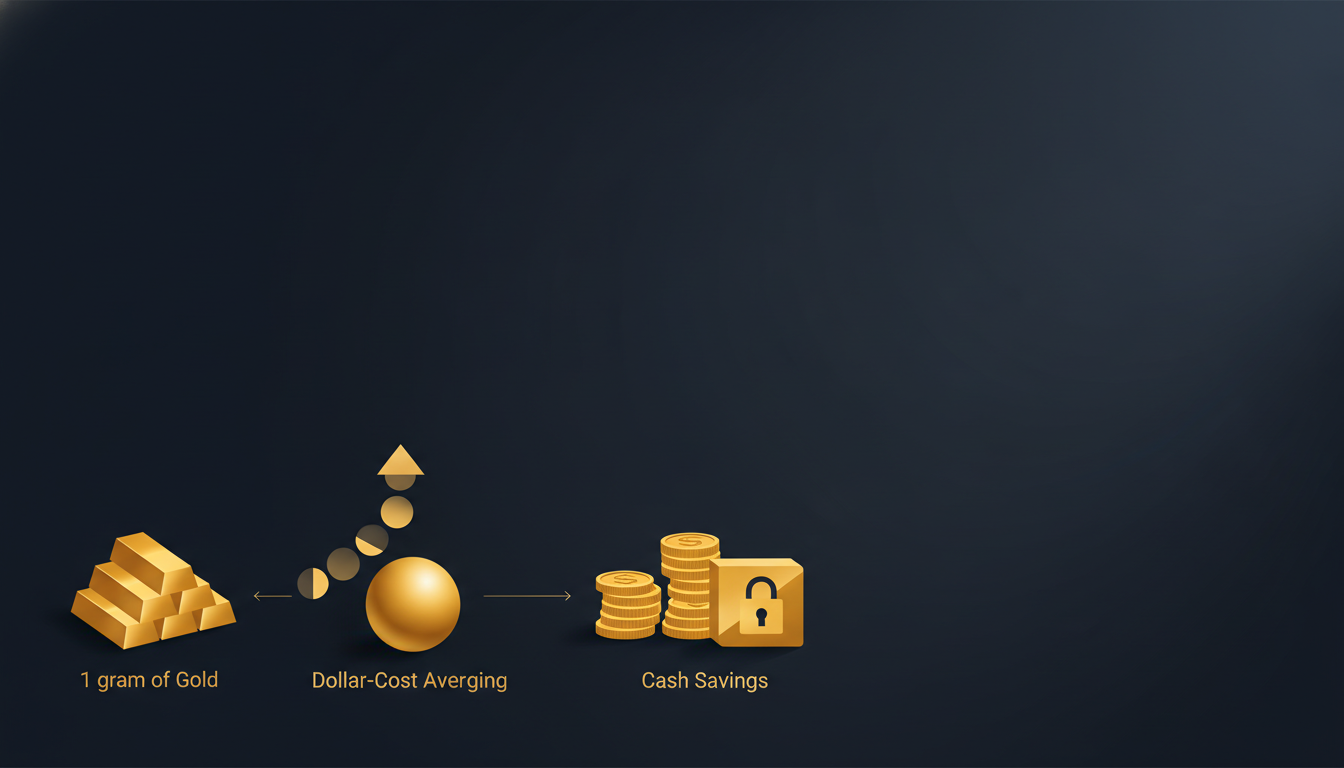
One gram of 22K gold costs around AED 466.72 in Dubai (see the live table above for the current figure). That's roughly what you'd spend on two restaurant meals, a tank of petrol, or a month of a streaming subscription you've probably forgotten about. The difference is that in ten years, the gold gram will almost certainly be worth more. The streaming subscription definitely won't.
Why Dollar-Cost Averaging in Gold Actually Works
Dollar-cost averaging (DCA) is a simple idea: you buy a fixed amount of something at regular intervals, regardless of price. When prices are high, your fixed budget buys less. When prices are low, it buys more. Over time, your average cost smooths out, and you stop trying to time the market — which almost nobody does successfully anyway.
Applied to gold, the math is straightforward. If you commit to buying one gram of 22K gold every month, your monthly outlay varies only as prices move. As an example, that has been around AED 466.72 in the UAE, SAR 476.57 in Saudi Arabia, or EGP 6,345.40 in Egypt (see the live table above for current figures). Next month it might be slightly more or slightly less. That's the whole point — you're not betting on any single entry price. You're accumulating.
After 12 months you'd hold 12 grams of 22K gold. After 24 months, 24 grams — roughly the weight of a medium-sized bracelet. After five years, 60 grams. At an illustrative 22K price of around $127.09 per gram (see the live table above for the current figure), that five-year stack would be worth over $7,600 at such rates. And gold's long-term direction has historically been upward, driven by dollar weakness, geopolitical demand, and central bank buying. Those forces haven't gone away.
The psychological benefit matters too. A fixed monthly habit removes the anxiety of watching charts. You're not waiting for a dip that may never come. You buy, you hold, you repeat.
Gold vs. Cash Savings: What You're Really Comparing
Let's be honest about what bank savings accounts actually do in most GCC and Egyptian markets. In many cases, you're earning a rate that struggles to keep pace with real inflation. The Egyptian pound has seen significant devaluation pressure in recent years. Even Gulf currencies, pegged to the dollar, are exposed to dollar purchasing-power erosion over long periods.
Gold priced in USD has risen substantially over the past two decades. An illustrative spot price of around $4,312.02 per troy ounce (see the live table above for the current figure) reflects a metal that was trading at a fraction of this level in the early 2000s. That long-run direction is what protects purchasing power in a way that a savings account denominated in a softening currency cannot.
Here's a direct comparison of what a one-gram-per-month gold habit looks like across GCC countries at example prices:
| Country | Currency | 22K price/gram | Monthly cost | Annual cost (12g) |
|---|
| UAE | AED | 466.72 | AED 466.72 | AED 5,600.64 |
| Saudi Arabia | SAR | 476.57 | SAR 476.57 | SAR 5,718.84 |
| Egypt | EGP | 6,345.40 | EGP 6,345.40 | EGP 76,144.80 |
| Qatar | QAR | 462.59 | QAR 462.59 | QAR 5,551.08 |
| Kuwait | KWD | 39.08 | KWD 39.08 | KWD 468.96 |
Now ask yourself: if you put those same amounts into a standard savings account, what do you have after five years? You have your principal, plus interest — but denominated in the same currency that's losing purchasing power. With gold, you have a physical asset priced in a global commodity market. Those are fundamentally different propositions.
The honest caveat: gold pays no income. It doesn't yield dividends or interest. If you need cash flow from your savings, gold isn't a complete solution. But as a store of value and a hedge against currency erosion, it earns its place in any personal finance plan.
Choosing Your Karat — and Why It Changes the Habit
The karat you choose affects both your cost and your eventual liquidity. Here's how the options stack up at illustrative example prices (see the live table above for current figures):
| Karat | Purity | Price/gram (USD) | AED/gram | SAR/gram | EGP/gram |
|---|
| 24K | 99.9% | $138.63 | 509.14 | 519.88 | 6,922.01 |
| 22K | 91.7% | $127.09 | 466.72 | 476.57 | 6,345.40 |
| 21K | 87.5% | $121.31 | 445.49 | 454.89 | 6,056.76 |
| 18K | 75.0% | $103.98 | 381.85 | 389.91 | 5,191.50 |
24K is the purest and most globally tradable form — used in investment bars from makers like PAMP Suisse, Valcambi, and Emirates Gold. If your goal is purely investment and resale, this is the most liquid karat.
22K is the dominant jewelry standard across GCC markets and Egypt. It's what most gold souks price and sell daily, and it's what most buyers understand. If you're accumulating through small gram bars or simple pieces, 22K gives you good liquidity with a slightly lower per-gram entry cost than 24K.
21K is popular particularly in Egypt and parts of the Levant. The per-gram cost in Egypt is around EGP 6,056.76 as an illustrative figure (see the live table above for the current figure) — meaningfully lower than 24K's illustrative EGP 6,922.01. For Egyptian savers on a tight monthly budget, 21K stretches further.
18K is primarily a jewelry karat. You can buy it, but resale involves a discount to pure gold content, and premiums on workmanship don't recover on resale. For pure savings purposes, stick to 21K, 22K, or 24K.
For the DCA habit specifically, most GCC and Egyptian investors find 22K the most practical: it's the karat quoted everywhere, easily bought in small gram increments, and highly liquid at any gold souk or licensed dealer.
Making the Habit Stick — Practical Setup
The biggest obstacle to any savings habit isn't the money. It's the friction. Here's how to reduce it:
Set a calendar reminder on the same day each month — the 1st works well because it coincides with salary cycles in GCC countries. Treat it like a bill payment, not a discretionary purchase.
Decide your format in advance. Small gram bars (1g, 2g, 5g) from accredited refiners are clean and stackable. If you prefer coins, the Canadian Gold Maple Leaf, South African Krugerrand, British Britannia, and Austrian Philharmonic are all available through licensed dealers in the region and carry global recognition. Don't let the choice of format become the reason you delay.
Store it properly. A small home safe works for modest quantities. For larger accumulations, allocated storage at a licensed vault or bank safety deposit box is worth the modest fee.
Track your average cost. Keep a simple spreadsheet: date, grams purchased, price per gram in your local currency. After six months, calculate your average cost per gram. That number — your personal DCA price — is what you compare to market price when you eventually decide to sell.
Don't obsess over timing. The entire point of DCA is that you're not trying to time the market. If you bought last month at AED 470 and this month it's AED 466.72, that's fine. Over years, these small fluctuations average out. Consistency beats cleverness.
You can check current gram prices by karat before each monthly purchase using the gold calculator at DahabPulse — it converts spot price to gram costs across all major karats and GCC currencies in real time.
Frequently Asked Questions
Q: How much does one gram of gold cost per month in the UAE?
One gram of 22K gold in the UAE is around AED 466.72 as an illustrative example (see the live table above for the current figure), based on an illustrative spot price of around $4,312.02 per troy ounce. If you prefer 24K investment-grade gold, you're paying around AED 509.14 per gram at such prices. Check live UAE gold prices at DahabPulse before each monthly purchase since the price shifts daily.
Q: Is buying one gram of gold a month a good investment strategy?
Yes — buying one gram of gold monthly is a practical form of dollar-cost averaging that removes the pressure of timing the market and builds a physical asset over time. Over 12 months at an illustrative 22K price of around SAR 476.57 in Saudi Arabia, you'd accumulate 12 grams worth approximately SAR 5,718 at such prices. The strategy works best as a complement to other savings, not a replacement for liquid emergency funds.
Q: Which karat is best for monthly gold savings in Egypt?
21K or 22K are the most practical choices for monthly gold savings in Egypt. At illustrative prices, 21K costs around EGP 6,056.76 per gram and 22K costs around EGP 6,345.40 per gram (see the live table above for current figures) — both are widely traded in Egyptian gold markets, making resale straightforward. 24K bars are the purest investment option at around EGP 6,922.01 per gram but are less commonly traded in smaller retail souk transactions.
Q: How does gold savings compare to a bank savings account?
Gold preserves purchasing power over long periods in a way that cash deposits in a weakening currency cannot, but it earns no interest or yield. A savings account offers liquidity and predictable (if modest) returns; gold offers a hedge against currency devaluation and inflation with full price transparency — an illustrative spot price of around $4,312.02 per troy ounce gives a sense of scale, and the live figure is visible globally in real time. The two work best together: cash for short-term needs, gold for long-term value storage.
Q: Where can I buy small gold bars in GCC countries?
Licensed gold dealers, major gold souks, and some banks across the UAE, Saudi Arabia, Qatar, and Kuwait sell small gram bars from refiners including PAMP Suisse, Valcambi, and Emirates Gold. Always buy from a licensed dealer and verify the refiner's hallmark on the bar. See live gold prices in Qatar and Kuwait to verify you're paying fair market rates before any purchase.
The habit you build in the next 12 months will matter more than any single price move. At around AED 466.72 or SAR 476.57 per gram as illustrative examples (see the live table above for current figures), the entry cost is real — but so is the long-term logic. Visit DahabPulse.com to check live gram prices in your currency before your next purchase, or use the gold calculator to see exactly what any weight and karat costs you in dirhams, riyals, pounds, or dinars right now.