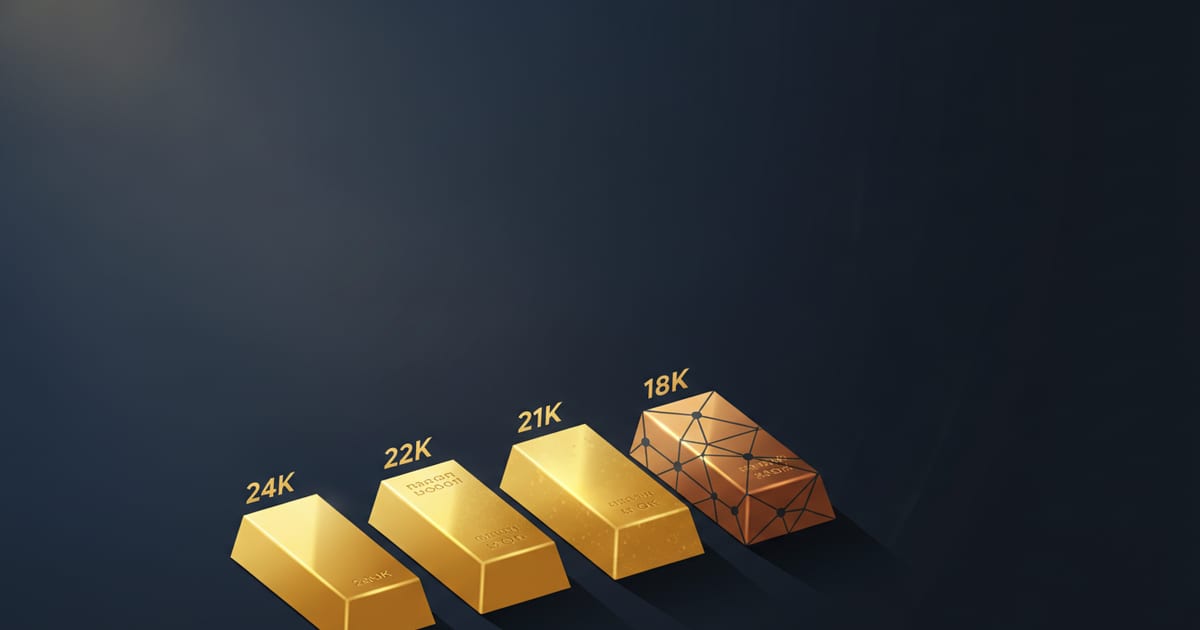
Walk into a gold souk in Dubai and you will see 21K bangles priced at around AED 490.39 per gram sitting two shelves above 24K bars at around AED 560.44 per gram — a difference of AED 70 on every single gram (see the live table above for the current figures). For a 20-gram necklace, that gap is AED 1,400 before you have even discussed the making charges. Understanding why that price exists, and which karat actually serves your purpose, is the difference between a smart purchase and an expensive mistake.
What Karats Actually Mean — The Chemistry Behind the Number
Karat is simply a measure of gold purity expressed as a fraction of 24 parts. Pure gold is 24 parts gold out of 24, which is why 24K is synonymous with 99.9% purity. Every step down the karat ladder replaces some gold with an alloy — usually copper, silver, zinc, or palladium — to change the metal's hardness, color, and cost.
Here is the precise breakdown:
- 24K — 99.9% pure gold. Soft, deep yellow, and the global benchmark for pricing. At around $152.60 per gram as an illustrative example (SAR 572.27 | EGP 8,046.23 | AED 560.44 | QAR 555.48 | KWD 46.91) — see the live table above for the current figure.
- 22K — 91.7% pure gold, with roughly 8.3% alloy. Harder than 24K, retains a rich yellow tone. Illustrative price: around $139.89 per gram (SAR 524.60 | EGP 7,375.98 | AED 513.76 | QAR 509.21 | KWD 43.00) — see the live table above for the current figure.
- 21K — 87.5% pure gold. The most widely traded jewelry karat across the Gulf and Egypt. Illustrative price: around $133.53 per gram (SAR 500.73 | EGP 7,040.45 | AED 490.39 | QAR 486.05 | KWD 41.05) — see the live table above for the current figure.
- 18K — 75% pure gold. Significantly harder, available in white and rose gold variants, and favored in European-style fine jewelry. Illustrative price: around $114.45 per gram (SAR 429.20 | EGP 6,034.67 | AED 420.33 | QAR 416.61 | KWD 35.18) — see the live table above for the current figure.
The math is straightforward: 18K gold contains 25% less gold than 24K, which is almost exactly reflected in these illustrative prices — $114.45 versus $152.60, a 25% discount. Markets are efficient here. What you pay is overwhelmingly what you get in gold content, which is why karat verification matters enormously when buying.
Which Karat Is Best for Investment — And Why the Answer Is Almost Always 24K
If your primary goal is to store value or build a position in gold, 24K is the rational choice — full stop. Here is why the math forces that conclusion.
When you buy 22K gold as an investment, you are paying for 91.7% gold content, but when you sell, buyers will discount the price to reflect that same 91.7% content. You have paid for alloy metal that earns no return. The spread between buy price and sell price is also typically wider on jewelry karats because dealers account for making charges, wear, and purity verification costs.
24K gold coins, bars, and certified bullion — the products available from DMCC-accredited refiners in Dubai, the Saudi Arabia Monetary Authority-recognized dealers in Riyadh, or the Central Bank of Egypt — trade closest to spot price. With spot at around $4,746.54 per troy ounce as an illustrative example (see the live table above for the current figure), a one-ounce 24K coin from a reputable dealer should price within 1–3% of that figure. A 22K piece of jewelry priced at the same weight will carry making charges of 10–25% on top of metal value, none of which you recover on resale.
For Egyptian investors in particular, where gold savings have historically outpaced bank deposit returns during periods of currency depreciation, 24K certified grams sold by licensed dealers offer the cleanest exposure to the gold price. At around EGP 8,046.23 per gram as an illustrative example (see the live table above for the current figure), a modest 10-gram holding represents EGP 80,462 in gold value — a meaningful hedge against pound volatility.
Kuwaiti and Qatari investors, operating in currencies pegged to the dollar, face less currency risk but still benefit from 24K's liquidity premium. At around KWD 46.91 per gram as an illustrative example (see the live table above for the current figure), gold remains one of the few assets accessible to retail buyers without brokerage accounts or minimum investment thresholds.
Which Karat Is Best for Jewelry — A Market-by-Market Reality Check
This is where regional preferences diverge sharply, and ignoring local norms is an expensive mistake if you plan to resell.
UAE and Kuwait: 21K dominates the jewelry market. Walk through the Gold Souk in Deira or the Mubarakiya market in Kuwait City and the overwhelming majority of traditional pieces — chains, bangles, wedding sets — are 21K. Buyers trust it, jewelers stock it, and the resale market is liquid. At around AED 490.39 per gram as an illustrative example (see the live table above for the current figure), a standard 10-gram bangle costs approximately AED 4,904 in gold value before making charges.
Saudi Arabia: 21K is again the standard for traditional jewelry, though 18K has gained ground among younger buyers purchasing European-design pieces. Saudi consumers are also sophisticated about gold weight — many will weigh pieces in-store and calculate value against the day's spot price before accepting a final price.
Egypt: 21K is the cultural default and the karat most commonly gifted at weddings and engagements. The Egyptian gold market is enormous and deeply embedded in family wealth transfer. At around EGP 7,040.45 per gram for 21K as an illustrative example (see the live table above for the current figure), a 15-gram set — not unusual for a bride's jewelry — represents EGP 105,607 in metal value alone. Making charges in Egypt tend to be lower than the Gulf as a percentage, which makes Egyptian-purchased jewelry slightly better value for the gold content.
Qatar: 21K and 22K both have strong presence. The Souq Waqif gold section caters to South Asian expatriates who traditionally prefer 22K, alongside Gulf Arab buyers who favor 21K. This dual demand makes Qatar's market uniquely liquid across two karats.
18K for jewelry makes the most sense when the design demands it — white gold engagement rings, diamond-set pieces, or intricate Italian-style goldsmithing that requires harder metal to hold settings securely. You are buying craftsmanship as much as gold. But do not confuse 18K jewelry bought for design with 18K as a value store. At around $114.45 per gram as an illustrative example (see the live table above for the current figure), you are paying for 75% gold and 25% alloy, and that alloy has zero resale value.
Purity Hallmarks and How to Verify What You Are Buying
Purchasing gold without verifying the hallmark is the single most common mistake buyers make, and it is entirely avoidable.
In the UAE, the Dubai Municipality mandates hallmarking on all gold jewelry sold in the emirate. Look for the karat stamp — 999 for 24K, 916 for 22K, 875 for 21K, 750 for 18K — alongside the Dubai Municipality logo and the retailer's registered mark. These three stamps together mean the piece has been independently tested.
In Saudi Arabia, the Saudi Standards, Metrology and Quality Organization (SASO) oversees hallmarking requirements. Compliant pieces carry similar numeric purity stamps.
In Egypt, the General Organization for Export and Import Control (GOEIC) mandates hallmarking, and pieces should carry the purity number plus the Egyptian assay office stamp. Buying from licensed jewelers registered with the Egyptian Federation of Gold and Jewelry is essential.
For any piece without clear hallmarking, insist on a written receipt that states the karat, weight in grams, gold price per gram on the day of purchase, making charge, and total price broken down. This receipt is your documentation for resale and, in dispute cases, your legal protection.
One practical tip: weigh the piece yourself. Any reputable jeweler in a GCC souk will have a scale behind the counter and will weigh the piece in front of you without hesitation. If a jeweler resists this, leave.
Frequently Asked Questions
Q: Is 21K gold available in international markets, or is it specific to the Arab world?
21K gold is strongly associated with GCC and broader Middle Eastern markets and is not a standard karat in European, American, or East Asian jewelry markets, where 18K and 14K dominate. This regional specificity means 21K pieces purchased in Dubai or Cairo may be harder to sell at fair value if you relocate to Europe or North America — something worth considering if your gold serves as a portable asset.
Q: If gold prices rise, do all karats benefit equally?
Yes — proportionally. If the gold spot price rises 10%, the intrinsic metal value of your 24K, 22K, 21K, and 18K gold all rise by 10%. However, 24K holders capture that gain most cleanly because their asset is purely gold. Lower-karat jewelry holders may find that making charges paid at purchase dilute the effective return, since those charges do not increase with the gold price.
Q: Why is 22K more common in South Asian gold jewelry than 21K?
This reflects historical and cultural standards set by Indian and Pakistani gold markets, where 22K became the traditional benchmark for bridal jewelry. South Asian expatriate communities in the Gulf — particularly in Qatar, UAE, and Kuwait — have maintained this preference, which is why 22K pieces are readily available and liquid in those markets alongside the Arab-preferred 21K.
Q: Can I melt down old jewelry and sell it as pure gold?
You can sell old jewelry for its scrap gold value, but buyers will apply a discount — typically 5–15% below spot price — to account for melting costs, assay fees, and uncertainty about alloy content. You will not receive the full per-gram price shown in live market data. If you hold a significant quantity of jewelry, getting competing quotes from two or three licensed scrap dealers is worth the time.
Q: Is buying gold in Egypt cheaper than in the Gulf right now?
The gold price itself tracks the same global spot rate regardless of country — what differs is the currency. At an illustrative exchange rate of 52.73 EGP per USD, 21K gold costs around EGP 7,040.45 per gram in Egypt as an example (see the live table above for the current figure). The equivalent in UAE dirhams is around AED 490.39. These are the same price converted through the exchange rate. What can differ is making charges — Egyptian jewelers often charge lower fabrication fees per gram than Gulf souks, meaning the all-in price for a finished piece may be slightly lower in Egypt.
For up-to-the-minute gold prices in every karat and every GCC and Egyptian currency, visit DahabPulse.com — updated continuously throughout the trading day. The site's gold calculator lets you enter any weight and karat to get the exact metal value in your local currency, so you can walk into any souk knowing precisely what you should be paying before the jeweler quotes you a price.